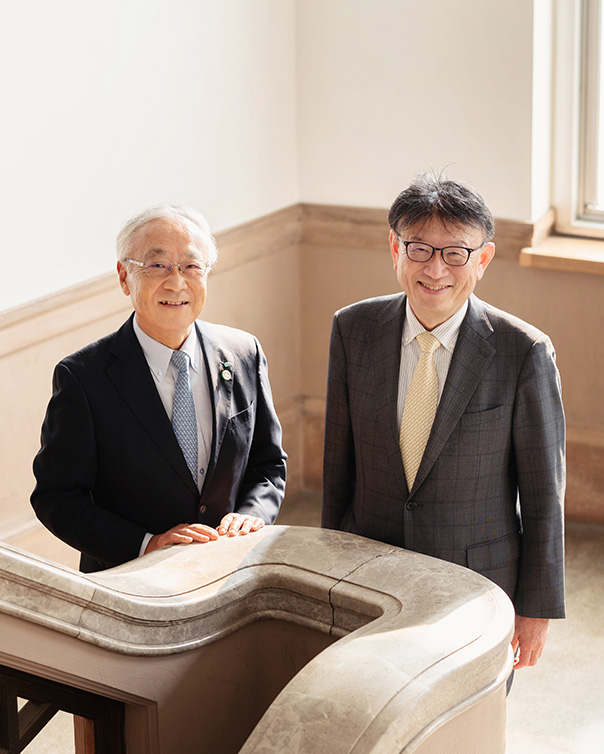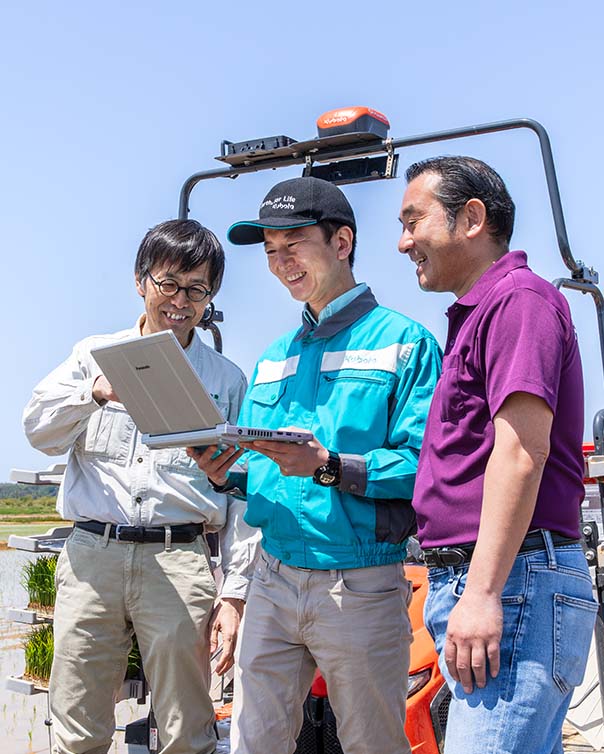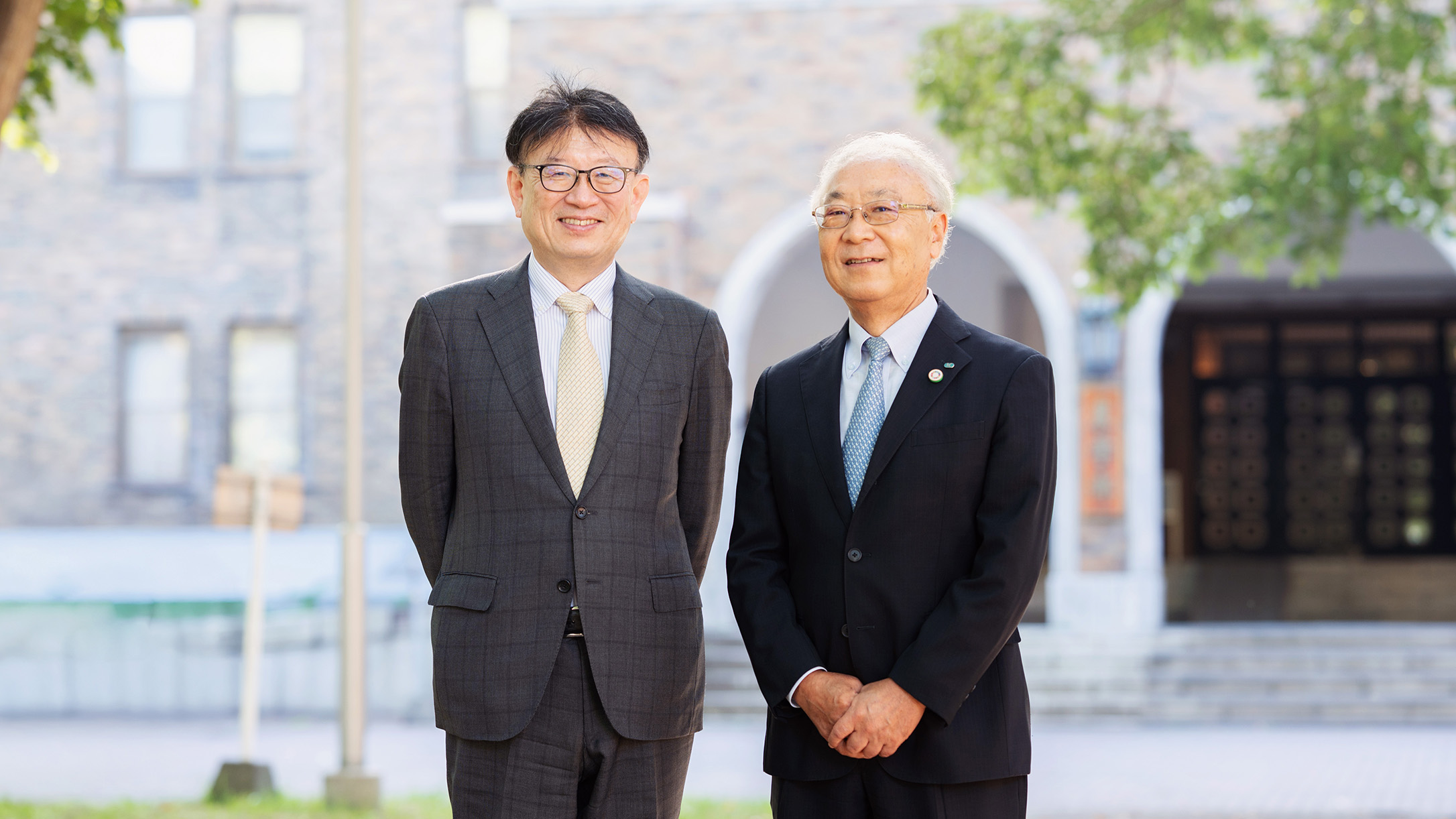
This is a conversation between two leaders of smart agriculture in Japan: Hokkaido University Professor Noboru Noguchi and Kubota Senior Technical Advisor Satoshi Iida. (Iida’s title and affiliation are those held at the time of the interview; retired at the end of December 2025) In the first half, they talked about progress in smart agriculture from 2019 to 2025 along with its current status and challenges. In this second half, we take a closer look at the future of smart agriculture and Kubota’s vision for “planetary-conscious agriculture.”
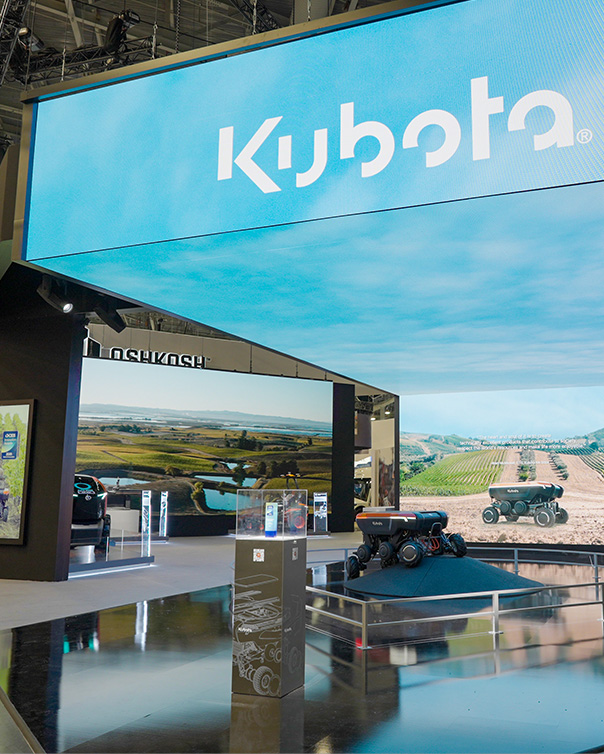
Planetary-conscious agriculture is a concept that Kubota presented at Expo 2025 Osaka for agriculture that is friendly to the Earth and to people. What do the two leaders think of this vision for agriculture, which aims to support the long-term well-being of the planet and all forms of life?
The Future of Robotic Agricultural Machinery and Expanding Crop Applicability
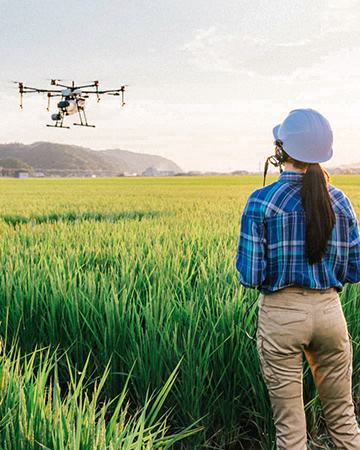
Next, I would like to talk about the orientation for smart agriculture research and development. First, how do you see the future of robotic agricultural machinery?
Iida: Going forward, I believe we need to expand the integrated smart agriculture system*1 beyond rice and dry-field farming to include vegetables and fruit trees. To make this possible, we will need to advance robotics technologies even further.
Kubota is currently strengthening its development work in Step 3, which envisions completely autonomous agricultural machinery that can operate without a person riding and is monitored remotely by the user. The major challenges in achieving Step 3 are traveling between multiple fields and driving on public roads. Operating on public roads requires safety measures and technologies that are entirely different from those in field work.
- *1. A new form of agriculture that uses advanced technologies such as robots, AI, and IoT in a systematic way throughout the production process, from management and cultivation control to harvesting, in order to improve productivity and quality while reducing labor.
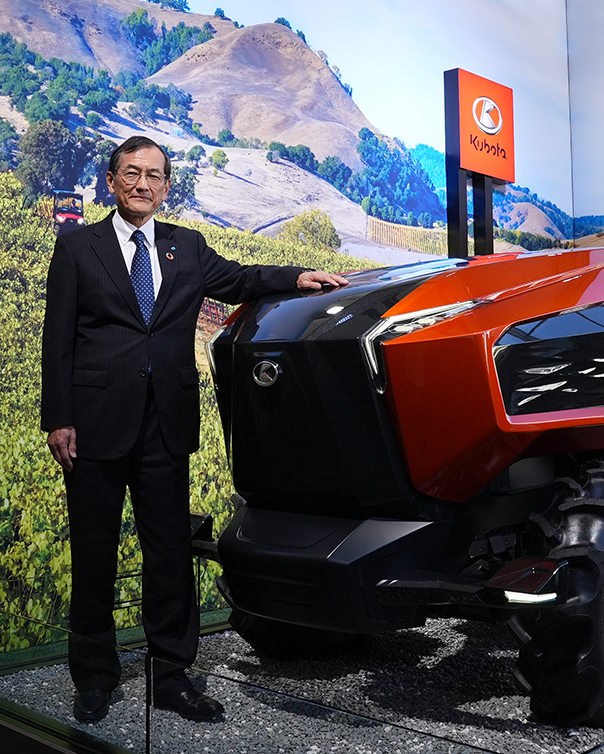
Iida: To expand the range of applicable crops, we also need new concept models. One example is the all-terrain platform vehicle designed by Kubota for use on uneven terrain.
This all-terrain platform vehicle was developed as a platform vehicle that can operate in places such as orchards in hilly or mountainous areas. We are currently looking for ways to increase its versatility and applicability through joint research with universities to see which attachments it should be equipped with and how they can be used.
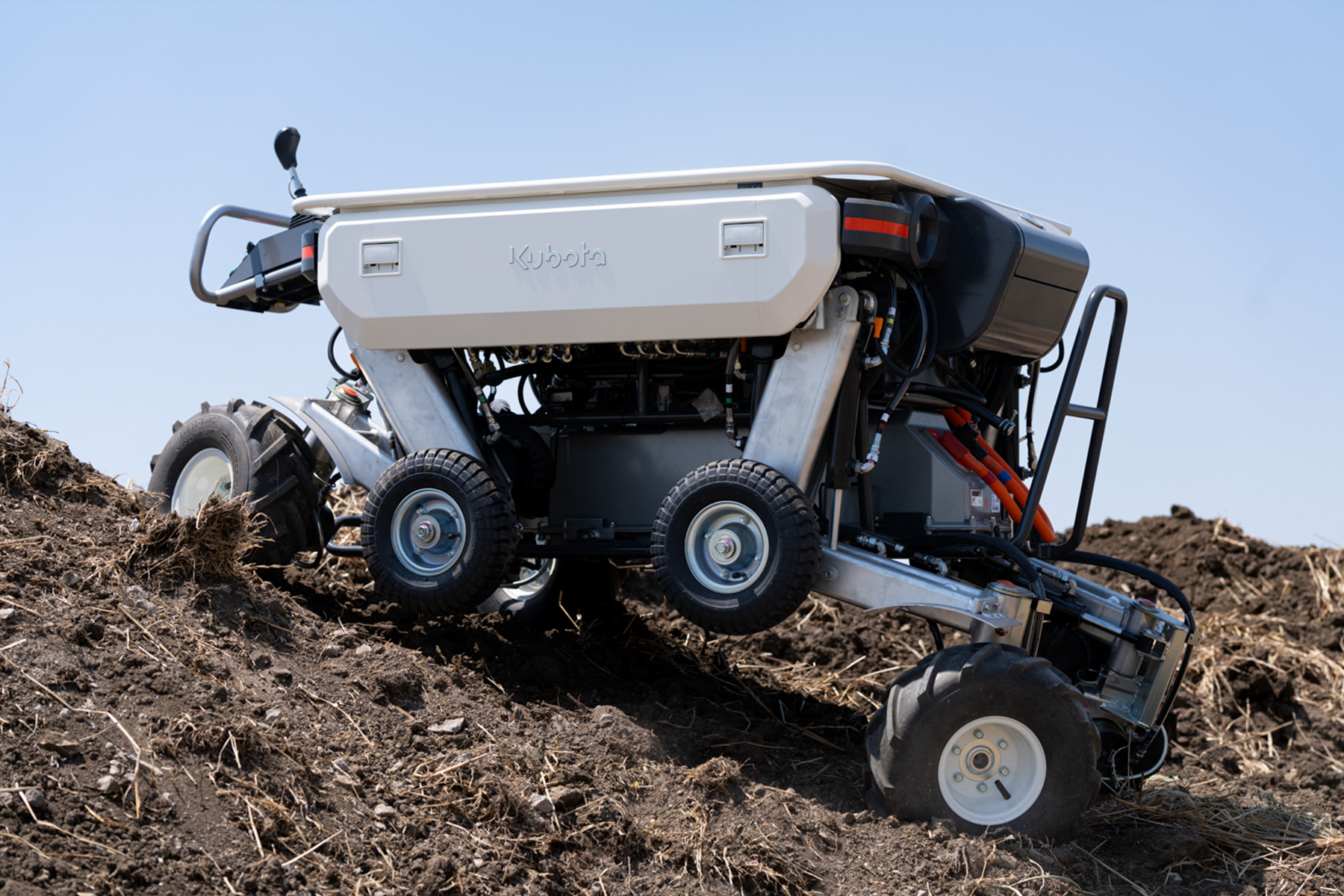
Prof. Noguchi: The vehicle is a unique machine that challenges conventional ideas around agricultural machinery, and I believe it has the potential to transform farmwork worldwide. Because it can operate on any terrain, it may even redefine our concept of “suitable sites” for farming.
It is very difficult for agricultural robots to work on the kinds of slopes commonly found in Japan and other parts of Asia. But if farmers have such machines, I sense real potential in actually making productive use of sloped land.
Iida: Weeding robots are also an important part of robotics technologies. Today, many older farmers still do their weeding work manually, not only along paddy ridges but also between rows of field crops and vegetables. Those responsible for this work may not be working in 15 years’ time, so developing robotic solutions is an urgent concern. In addition, compatibility with various implements and making them intelligent will be essential for advancing unmanned and automated operations with field crops, vegetables, and fruit production.
Precision Farming System (FMIS) Solutions for the Future of Data-Driven Agriculture
What is your vision for the future of precision farming driven by data?
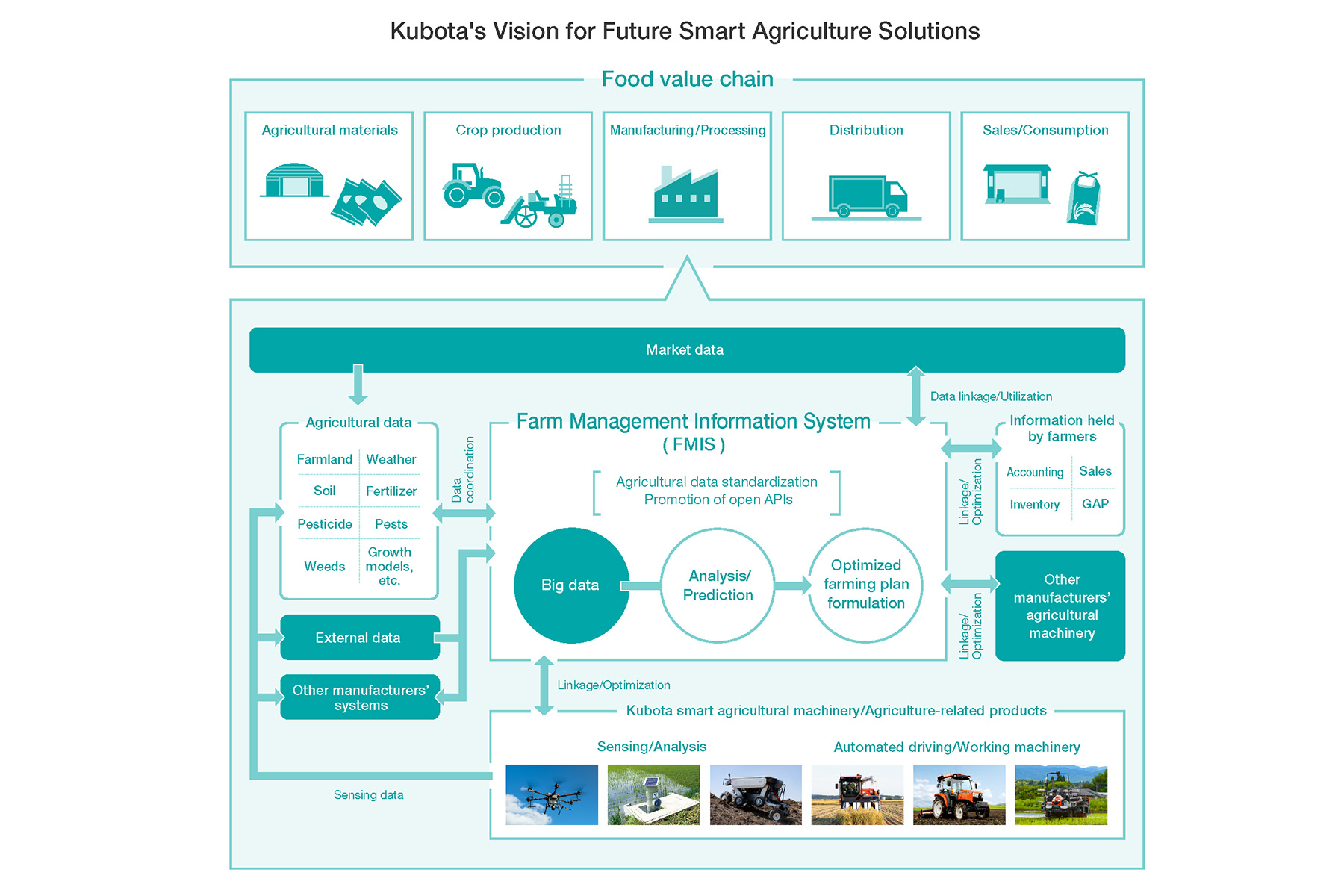
Iida: In the field of data-driven agriculture, we have set our sights on Phase 3 of Kubota's precision farming system (FMIS). While Phase 2 focused on “visualizing cultivation and implementing optimal operations based on data,” Phase 3 is about “building a proposal-based system” for farm management and cultivation. Based on layered maps that superimpose various kinds of data, our FMIS offers solutions for “right crop, right place” planting plans that plant crops suited to the type of soil, as well as work plans for optimal timing that take costs and climate change into account. It would be ideal if we could also offer farm management simulations that calculate expected profits based on those plans.
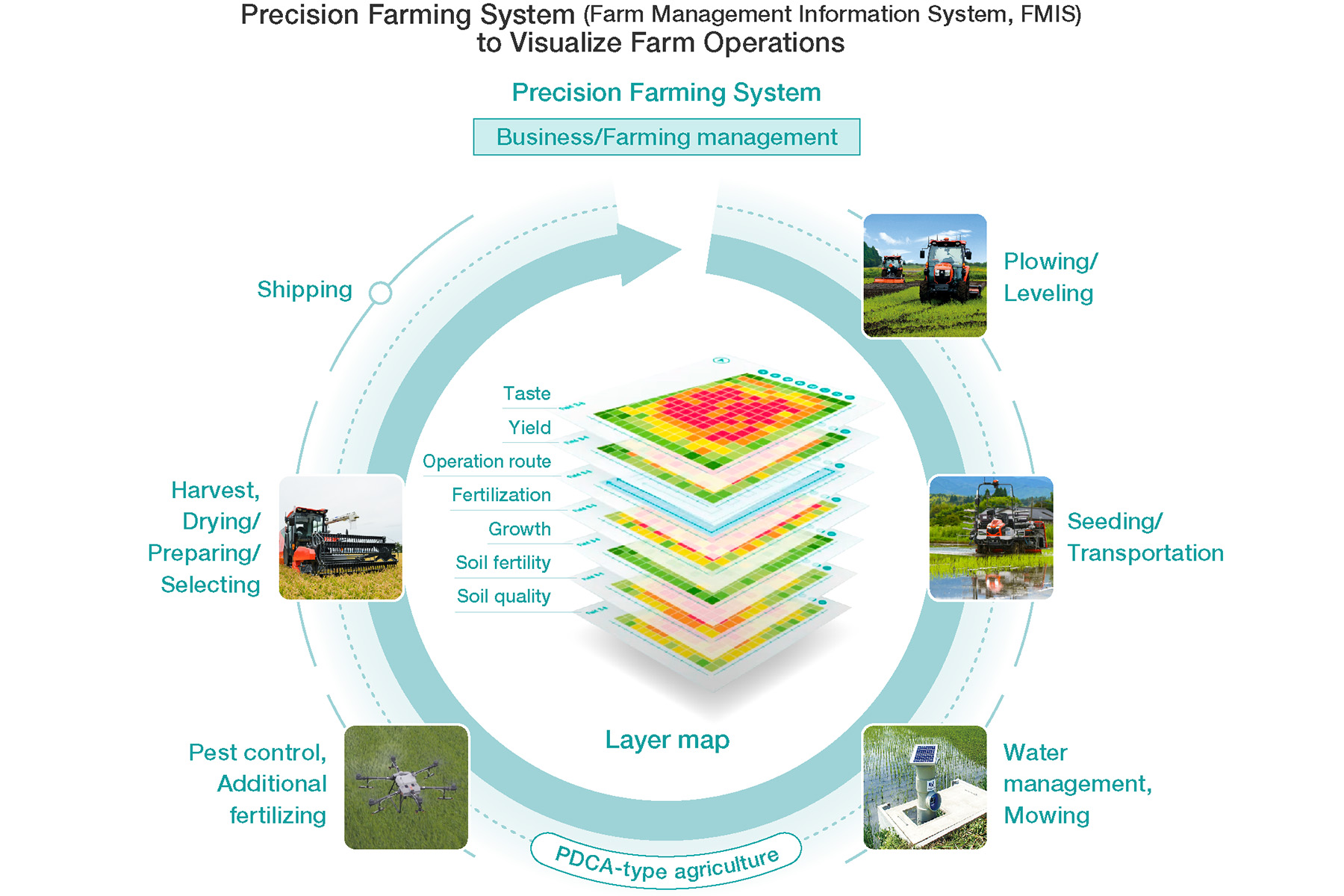
Iida: We also need to link with the food value chain*2, which connects food production data with markets and consumers. Currently, data such as yield forecasts and quality information are not being sufficiently linked, so valuable data is not being used to increase the value of crops.
- *2. A term for the interconnected stages spanning from the production and sale of agricultural materials to crop production, processing, distribution, sale, and consumption.
Prof. Noguchi: Connecting with markets is essential when we think about the future of smart agriculture. To truly achieve profitable farming, we need to model and optimize the entire supply chain from production to consumption. Expanding data-driven farming to include the consumption stage, gathering consumer preferences in the form of data, and optimizing the entire food value chain will become increasingly important.
Are there any other expectations you have regarding the roles of data-driven agriculture in the future?
Prof. Noguchi: One is contributing to stability in production even during significant climate change. As the climate shifts, planting areas will also transition, allowing crops to be grown in certain regions where they could not have been cultivated before.
In those different regions, farmers may not know the best cultivation methods for the crops, so data and cultivation techniques from the regions where the crops were grown before the climate changed will be valuable. Of course, there will be differences in soil, so not everything can be easily applied; but it would still serve as an important reference.
In other words, cultivation data will be able to be applied across wider regions, leading to more stable production and sustainability in farming. I believe that extending data across both time and geography, and ideas for expanding where and how that data is used, will become increasingly important.
And to obtain that data, collaboration with robotic agricultural machinery will be essential, won’t it?
Iida: Yes, it will. By analyzing big data collected from external sources such as advanced sensing technologies and markets, AI will be able to generate optimal farm management and work plans that take the entire food value chain into account. And based on those, agricultural machinery will then do the work, and then it will use sensors to evaluate the results. By repeating this cycle, we aim to build a platform that supports a wide variety of crops. Kubota cannot realize this vision alone; collaboration across industry, government, and academia is essential. Ultimately, our goal is to work so that FMIS evolves into a true “digital partner” for farmers.
The Requirements for Realizing Planetary-conscious Agriculture
Tell us about planetary-conscious agriculture, the future of agriculture envisioned by Kubota.
Iida: We at Kubota saw Expo 2025 Osaka as the ideal venue to clearly express our vision for the future of agriculture, so we adopted the concept of planetary-conscious agriculture. Given the status of our planetary boundaries, this approach embodies our belief that we must shift away from a human-centered perspective and consider the future of food and agriculture from an “Earth First” standpoint. This vision consists of three major directions.
Planetary-conscious Agriculture: 3 Directions
1. Complete Automation and Clean Energy Use for Farmwork
- Achieving unmanned farmwork through collaboration between autonomous robotic agricultural machinery and humans
- Achieving cooperative work (group control) through communication between multiple agricultural machines
- Reducing greenhouse gas emissions with new power mechanisms (BEV, HEV, FCEV*3, etc.)
- *3. BEV: Battery Electric Vehicle、HEV: Hybrid Electric Vehicle、FCEV: Fuel Cell Electric Vehicle
2. Sustainable Food Systems Connected Using Data
- Visualization of weather, soil, growth conditions, and pests through precision agriculture systems, and optimal farmwork proposals (reduced fertilizer and pesticide use, water conservation, etc.) based on data analysis AI and growth simulations
- Smart organic farmwork systems linked with agricultural robots (effective soil maintenance using mechanical weeding, organic materials, green manure, etc., along with IPM*4)
- Integration with external data facilitated through conversion to open platform (Market Place)
- Food waste reduction using just-in-time (JIT) production through data linked with the food value chain
- *4. IPM: Integrated Pest Management
3. Effective Use of Agricultural Resources
- Energy conversion including biogas-based green hydrogen production through methane fermentation from agricultural residues (rice straw, rice husks, etc.) and gasification technologies; resource recycling using biochar, liquid fertilizer, etc.
- Farm management-model solar power generation effectively utilizing the space above farmland
- Phosphorus recovery from sewage sludge using a rotary melting furnace and fertilizer utilization technology, etc.
Iida: The foundation of planetary-conscious agriculture is smart agriculture. With smart agriculture, we can reduce fertilizer and pesticide use and save both water and energy. Building on that, we add three essences: eco-conscious and sustainable smart agriculture, clean energy models of agricultural machinery, and resource recovery and recycling of agricultural residues. In particular, for resource recycling, we aim to integrate this with the technologies developed by our Water & Environment Division.
Prof. Noguchi: That is a vision that I think should be realized. If we do not take a recycling perspective in food production, waste will only continue to grow. Recycling is essential for building a sustainable society, and it is important that we develop systems that make this a positive, practical reality in agriculture as well.
Prof. Noguchi, from your point of view, what is required to further advance this vision?
Prof. Noguchi: While improving each individual technology is fundamental, what matters even more is integrating them, which means making them into a system. Even if every component functions properly on its own, that does not mean they will form an optimized system when combined. I believe the ability to design this system in a way that achieves balance between technologies and functions cohesively as a whole is absolutely essential.
What approach would help to overcome those challenges?
Iida: The key is on-site demonstrations. For example, for our methane fermentation green hydrogen production system that uses rice straw as a raw material, we are conducting trials in Ogata Village, Akita Prefecture, that cover aspects from efficient rice-straw collection to overall business feasibility. We are also collaborating with other universities, including Waseda University and Kyoto University, to operate an experimental plant. In this way, collecting multiple and continuous on-site evaluations is crucial for social implementation, including feasibility as a business.
Additionally, as we work to promote eco-friendly agriculture in concrete ways, we are giving priority to soil maintenance using organic materials and green manure. Crop productivity depends not only on weather conditions but also on soil health. How can we assess and maintain this health? This is an extremely important matter.
Hopes for the Engineers and Researchers Who Will Shape the Future
Finally, what are your expectations for university and graduate students, as well as young engineers and researchers who will shape the future of smart agriculture?
Prof. Noguchi: Many students today have a keen interest in food and environmental issues and take them seriously. What is more, they find great motivation in the fact that cutting-edge technologies they are already familiar with, such as AI and ICT, are now in high demand in the field of agriculture. The generation that will be responsible for future food production and the realization of a resource circulation society is being trained well, and I have high expectations for them.
Iida: Above all, what I expect from them is a thoroughly hands-on approach. I want them to go out into the field first, and then to develop a clear sense of what they want to do and where their interests lie. Without strong determination, it’s difficult to achieve anything in the private sector.
And in terms of being a private company, a “marketing” perspective is also essential. I hope they will become developers who not only listen to customers’ concerns but also identify the underlying needs behind them and provide value.
They should come up with concepts in an agile way, test them with customers, and conduct repeated trials. They need to understand the framework of industry-academia-government collaboration, and work with universities and startups while respecting the role of each. Above all, I want them to build organizations with active communication for sharing a common vision and work as a team with passion and perseverance to find solutions.
Prof. Noguchi: When you are young, focusing deeply on a single theme rather than spreading yourself too thin will lead to significant growth later on. Our role as educators is to keep giving goals to students interested in our field that make them think, “Wow, I didn’t know this world was so fascinating!” With such an appealing vision, young people will take the initiative.
Iida: Over the past 14 years, I have been able to stay so passionately involved with smart agriculture because of my colleagues who share a vision and work tenaciously to overcome challenges, as well as everyone who has contributed so much through joint research, including Professor Noguchi. Another reason is my strong belief that technological development will lead to future world-class innovations in light of Japan’s advanced aging society. Passion is the driving force behind this, and I hope young engineers and researchers will continue to value the passion that drives them.


Related Articles